12 breakfasts
Weeks one to four. Fifteen minutes of hands-on time or less, starting with three that need no cooking at all and building to eggs and baking.

Ten Saturdays, thirty-two meals. Twelve breakfasts, eight lunches and twelve dinners, cooked from scratch and taken home on a card you can read — so that at the end of it there is a week of food you can make on your own. Starts 14 November at Helensvale.
The course
Not a demonstration class. Participants do the cooking, every week, and the recipes were chosen because they are the meals a person actually needs to be able to make for themselves.
Weeks one to four. Fifteen minutes of hands-on time or less, starting with three that need no cooking at all and building to eggs and baking.
Weeks five and six. Four cold and four warm — the kind of thing you make at midday without planning it the night before.
Weeks seven to nine. One-pan meals, family favourites, then fish and bakes, with a food thermometer and a real check that the chicken is cooked.
Cost
The same price and the same terms as our baking course. Here is exactly what is charged, so you or your plan manager can check it before you commit to anything.
$1,400
$140 a session × 10 weekly sessions
Claimed session by session, never charged upfront.
Claimable through your planEvery session includes
Enquiring costs nothing and commits you to nothing — we will check your funding fits before anyone signs anything.
How payment works. The course is claimed one session at a time, as each session is delivered — $140 a session. It is not charged as a lump sum before the course starts, and you are never invoiced for a session that has not run.
Trying one session first. You do not have to commit to ten weeks to find out whether it suits. A single come-and-try session is $140, and if you carry on, it counts as your first week.
Getting there. Pick-up and drop-off is available if transport is the thing standing in the way. It is optional, quoted separately at $140 a session, and claimed against your transport or core supports rather than the course itself.
Leaving the course. If a participant decides to stop, we ask for two weeks' notice in writing. Sessions delivered during those two weeks are claimed as normal, and nothing is charged for the weeks after the notice period ends. That is about leaving the course — an occasional absence is handled under the short notice cancellation rules in the NDIS Pricing Arrangements and in your service agreement.
Nothing here limits your rights under the Australian Consumer Law. If we cancel a session or do not deliver the course as described, you are not charged for it and you are entitled to a remedy.
The same support items as our baking course, because it is the same kind of support delivered the same way. Which one applies depends on what is approved in the participant's plan; coordinators and plan managers are welcome to quote these directly.
09_009_0117_6_3
09_008_0116_6_3
04_599_0136_6_1
04_102_0136_6_1
04_599_0136_6_1
Week by week
Week one is overnight oats, a parfait and a smoothie — nothing hot, nothing sharp, and three things finished and eaten by the end of the session. Confidence first, then the cooktop.
In the weeks with four recipes, each pair cooks one or two dishes and everybody tastes all four. Every participant takes home the full set of cards regardless.
Christmas break. There is no class on Saturday 26 December or Saturday 2 January. Week six is 19 December, week seven picks up on 9 January, and graduation is Saturday 30 January 2027. Nothing is claimed for the two weeks we do not run.
A typical session
The routine does not change, because for a lot of participants knowing exactly what happens next is what makes the rest of it possible.
Hand washing, aprons on, and a look at today's recipe cards before anybody picks anything up.
A demonstration of a single thing: a safe knife grip, cracking an egg, or checking with a thermometer that chicken is cooked through.
In pairs or at rotating stations, following picture recipe cards, with staff stepping back as the weeks go on.
Everybody sits down to what the group made, and we talk about the healthy plate: half vegetables, a quarter protein, a quarter wholegrains.
Washing up is part of cooking, not something done for you. Leftovers go into labelled containers to take home.
What I made today, and what I am going to cook at home this week. The second half is the point of the course.
In the kitchen
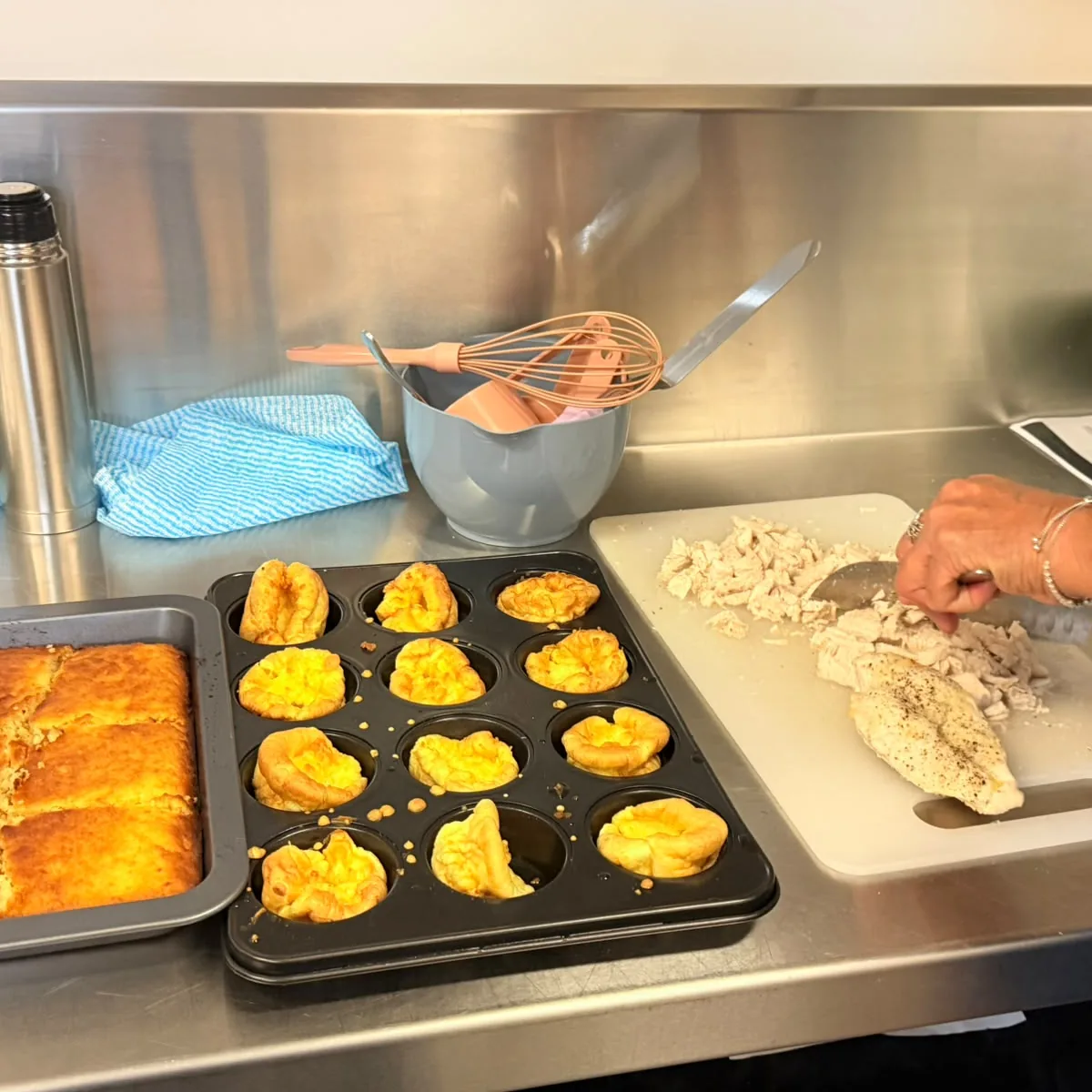
This is a bench partway through one of our savoury sessions — cornbread out of the oven, a tray of Yorkshire puddings, and a participant slicing the chicken for everyone to share.
Nobody is watching a demonstration. Every pair has a station, a picture recipe card and a job, and the facilitator steps back a little further each week. What comes out of the oven is lunch, and whatever is left goes home in a labelled container.
What it builds
Written as outcomes rather than aspirations, because this is the language a support coordinator needs to match the course to a plan. Each one is something that genuinely happens in the kitchen.
A simple breakfast, lunch and dinner, made on their own or with light support — which for some participants is the first meal they have ever cooked without somebody else at the bench.
Reading an easy-read card with one step per line, gathering what is needed, and working through the steps in order without being prompted through each one.
Knife, oven, cooktop, microwave and blender, plus hand washing, colour-coded boards and a thermometer check on chicken and mince.
Writing a shopping list and a one-week meal plan on a budget — the week-ten task, and the part that keeps working long after the course finishes.
Cooling and labelling leftovers, keeping them the right length of time, reheating them properly, and throwing away less food.
The healthy plate is taught by building it and then eating it every week, rather than as a rule on a handout. Nobody is weighed and nothing is forbidden.
Access, diets and allergens
A cooking class has more ways to exclude somebody than a baking class does — bench height, hand strength, knives, heat and what a person is able to eat. So each of those is planned before the course starts rather than worked around on the day.
If there is a meal plan, the meal plan wins. These are general healthy-eating meals, not medical diets. Where a participant has a plan from a dietitian or a speech pathologist, that plan is followed and the recipe is adapted to it — never the other way round. Send us the plan at intake and we will tell you honestly which weeks need changing.
Allergens are known in advance. Every participant completes an intake form covering allergies, intolerances, and cultural or religious food needs. From those we build a class allergen register and check it against each week's recipes before the session. Peanut, fish, shellfish, eggs, dairy and gluten all appear somewhere in the thirty-two, and any of them can be swapped out.
Everything you need to know
Where it runs
Classes run from the teaching kitchen at Helensvale Library & Cultural Centre on the Gold Coast — one level, parking at the door, and the room our baking course ran in for its first three intakes. Baking has moved south to Palm Beach so that both courses can run on the same Saturday morning.
The course also travels. We deliver it inside SIL houses, group homes and aged care facilities, which is often the better option: residents learn in the kitchen they will actually be cooking in, and nobody has to be transported anywhere. We bring every piece of equipment, including portable cooktops where a kitchen does not have them.
Our Helensvale page has the practical detail on the venue, and this page covers how a course runs inside a facility.
Common questions
Enquire about a place
The first intake starts Saturday 14 November and takes five participants. Tell us a little about who the place is for and we will confirm availability and send through what you need to get started.